You were on the pour, or working near a wall going up, doing the job the way you were trained to do it. Then the form gave way, or you fell onto rebar that should have been capped, or a section of unbraced wall came down before it had any business standing on its own. Concrete and masonry construction accidents in New York are not freak occurrences. They are almost always the result of a specific, identifiable safety failure, and New York law gives injured workers a way to hold the responsible parties accountable.
Who is Responsible After a Concrete or Masonry Accident?
Concrete and masonry construction accidents in New York, including formwork collapses, rebar impalement, and masonry wall failures, are governed by federal OSHA standards and New York's Industrial Code Rule 23. When an owner or contractor fails to brace forms, guard exposed rebar, or support a masonry wall properly, an injured worker can pursue a third-party negligence claim against the owner and contractor under New York Labor Law.
Key takeaways
- Formwork, the temporary molds and shoring that hold concrete until it cures, must be structurally braced under both federal OSHA rules and New York's Industrial Code. A collapse is rarely bad luck; it usually traces back to inadequate bracing or a skipped inspection.
- Protruding rebar that a worker could fall onto must be guarded against impalement. This is one of the most specific, plainly written safety rules in all of construction law.
- Because concrete and masonry injuries happen on active job sites, injured workers generally have a third-party Labor Law claim against the property owner and general contractor, separate from and in addition to any workers' compensation benefits.
What Causes Concrete and Masonry Accidents on NY Construction Sites?
Most serious concrete and masonry injuries trace back to one of a small number of recurring failures, each with its own specific safety rule attached.
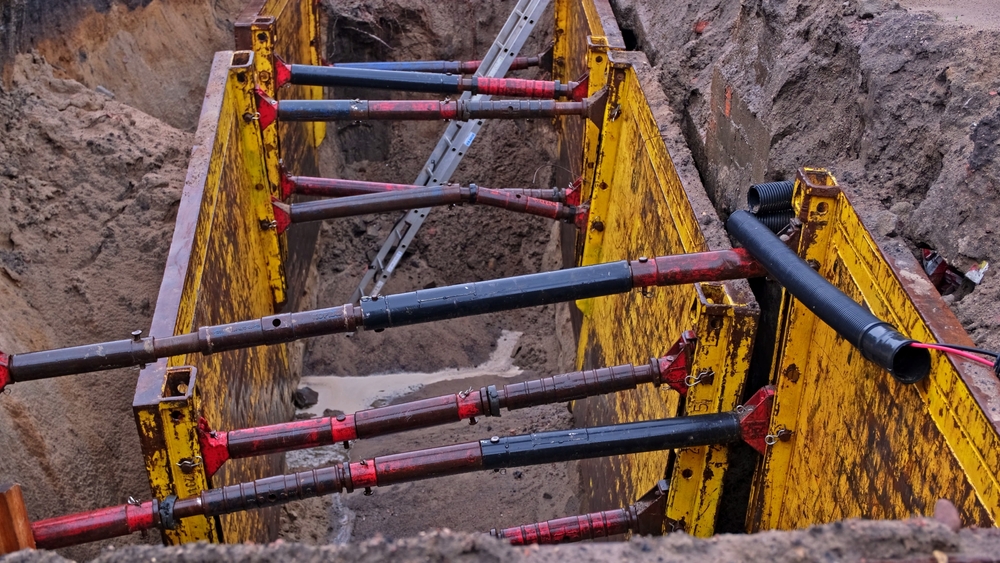
- Formwork and shoring collapse. The forms and shores that hold wet concrete in place until it cures must be structurally sound and properly braced. A collapse during or after a pour can crush, trap, or bury workers.
- Rebar impalement. Reinforcing steel left exposed and unprotected creates a fall hazard where the fall itself is the least of the danger. Workers have been seriously injured or killed falling onto unguarded rebar.
- Masonry wall collapse. A freestanding masonry wall under construction has no structural support until the roof or floor system ties it in. Without proper bracing, wind loads alone can bring a wall down.
- Struck-by injuries during pours. Concrete buckets, pump hoses, and chutes that fail or swing unexpectedly can strike workers with significant force.
- Chemical burns from wet concrete. Wet concrete is caustic, and prolonged skin contact without proper protective equipment causes real chemical burns, not just irritation.
- Silica dust exposure. Cutting, grinding, or drilling concrete and masonry releases fine silica dust linked to serious long-term respiratory disease when ventilation and dust controls are inadequate.
Why Formwork Failures Happen
A formwork collapse almost never happens without a warning sign that was missed or ignored. Federal safety standards require shoring equipment to be inspected before erection and again immediately before, during, and after concrete placement, and any equipment found to be damaged or weakened must be reinforced immediately. When that inspection step gets skipped to save time, the structure is carrying a load it was never verified to handle.
What Safety Standards Apply to Concrete and Masonry Work?
Two overlapping sets of rules govern this work, and both matter to a Labor Law claim. Federal OSHA standards for concrete and masonry construction set the baseline safety requirements nationwide, including the specific rule that all protruding reinforcing steel onto which an employee could fall must be guarded to eliminate the impalement hazard.
New York adds its own layer through the Industrial Code, known as Rule 23, which New York courts have applied to require that forms, shores, and reshores used in concrete work be structurally safe and properly braced or tied together to maintain their position and shape. That specific Rule 23 provision is what gives an injured worker a claim for Labor Law 241(6) and Rule 23 violations, separate from ordinary negligence, when a form fails.
- OSHA sets the general federal floor for concrete and masonry safety nationwide
- New York's Industrial Code Rule 23 adds specific, detailed requirements, outlined in the Rule 23 safety standards, that support a Labor Law 241(6) claim when violated
- A violation of either standard is strong evidence in a New York injury claim, even though only the state Industrial Code creates the specific statutory claim
Who Is Responsible for a Concrete or Masonry Accident?
The property owner and general contractor, generally, regardless of who employed the worker or which subcontractor poured the concrete or laid the block. New York's Labor Law places responsibility for an unsafe work site on the owner and general contractor because they control the project as a whole, not just the workers who directly caused a specific hazard.
- The property owner, who is responsible for site safety under the Labor Law even without direct control over daily work
- The general contractor or construction manager, who is responsible for coordinating safety across every trade on site
- The concrete or masonry subcontractor, if that specific subcontractor created the hazard
- An engineer of record or formwork designer, when the formwork design itself was inadequate for the load
This third-party Labor Law claim is what allows full recovery of the real cost of a serious injury, including pain and suffering.
Formwork gets stripped and the site gets cleaned up fast after an incident. Call (212) 406-1700 for a free case review, 24 hours a day, 7 days a week, or request a free case review online before the evidence disappears.
Do I Have a Claim Against the Owner and Contractor, Separate From My Employer?

Yes, in almost every concrete or masonry accident. New York law lets an injured construction worker pursue the property owner and general contractor directly for an unsafe work site, even though you generally cannot sue your own direct employer. This third-party claim is what actually accounts for the real cost of a serious injury: full lost earnings, future medical care, and pain and suffering.
- Have an attorney evaluate the claim against the owner, general contractor, and any other responsible party as soon as possible after the accident.
- Preserve evidence from the site, including photographs of the formwork, shoring, or wall condition, before cleanup or repair work erases it.
- Identify every entity on site, since concrete and masonry work frequently involves multiple subcontractors and an engineer of record.
- Keep copies of any incident report, OSHA citation, or internal safety review connected to the accident.
- Coordinate the timing of medical treatment and any other benefits you receive with your attorney, so nothing you do in one process weakens the other.
How Long Do I Have to File a Construction Accident Claim in New York?
Three years from the date of the accident for claims against a private owner or contractor. If the site was owned by a public entity, a city, a school district, or a public authority, a formal notice of claim is generally required within 90 days, with the lawsuit itself due within one year and 90 days.
- Private owner or contractor: three years from the accident
- Public project or public owner: notice of claim within 90 days, lawsuit within one year and 90 days
- Wrongful death: two years from the date of death
Frequently Asked Questions About Concrete and Masonry Accidents
What if I was working for a subcontractor, not the general contractor?
You can still bring a Labor Law claim against the property owner and general contractor, since New York holds both responsible for site safety regardless of which company directly employed you. Your own direct employer generally is not a defendant in the lawsuit, but every other responsible party on the project remains one.
Does it matter if I was not wearing all the protective equipment I was supposed to have?
It may come up as a factor, but it does not automatically defeat a Labor Law claim. Depending on which specific Labor Law section applies, an owner and contractor's failure to provide proper protection can outweigh a worker's own conduct, particularly for hazards like unguarded rebar that the owner and contractor were independently required to eliminate.
What if the formwork was designed by an engineer, not built wrong by the crew on site?
An inadequate design is still a basis for liability, just against a different party. If the formwork itself was designed to carry less load than the pour actually required, the engineer or formwork designer may share responsibility alongside the owner and contractor.
Can I recover for a chemical burn from wet concrete, or only for a fall or a collapse?
Yes. Wet concrete chemical burns are a recognized construction injury, and when they result from inadequate protective equipment or a failure to warn about the caustic nature of the material, they can support a claim the same way a fall or struck-by injury would.
The Pour Does Not Wait, and Neither Should Your Case

Concrete work moves fast, and so does the cleanup after an accident. Formwork gets stripped, walls get rebuilt, and rebar gets capped the moment an inspector or attorney is expected on site.
As New York construction accident attorneys, we at Washor Kool Sosa Maiorana & Schwartz, LLP investigate concrete and masonry accidents against both the federal OSHA standards and New York's Industrial Code, because a violation of either strengthens the case. Our attorneys have recovered over $1 billion in verdicts and settlements, and construction accident litigation is our firm's core practice. Call (212) 406-1700 any time, day or night, for a free case review.
This article is for informational purposes and is not legal advice. Every case depends on its own facts.
Washor Kool Sosa Maiorana & Schwartz, LLP
(212) 406-2313Attorney Advertising. Prior results do not guarantee a similar outcome.