Who is responsible if you slip and fall on a sidewalk in NYC?
In most cases, the owner of the property next to the sidewalk is responsible under Section 7-210 of the NYC Administrative Code. The city stays responsible next to city property and owner-occupied one-, two-, and three-family homes.
If you tripped on a broken sidewalk in New York City, the owner of the adjacent property is usually responsible, not the city. Section 7-210 of the NYC Administrative Code requires most owners to keep that sidewalk reasonably safe, which is why sidewalk slip and fall liability in NYC usually rests with them.
The city keeps responsibility in a few situations, and those claims carry stricter proof rules and shorter deadlines. If you were hurt on a broken or icy sidewalk anywhere in the five boroughs, Washor Kool Sosa Maiorana & Schwartz, LLP can review your case for free and help identify who is responsible.
Schedule a Free Case Evaluation
What to Know About NYC Sidewalk Slip and Fall Liability
These points summarize who answers for a fall on a New York City sidewalk:
- Under Section 7-210 of the NYC Administrative Code, the owner of the property next to a sidewalk is usually responsible for broken or icy conditions.
- The City of New York stays responsible for sidewalks next to owner-occupied one-, two-, and three-family homes used only as residences, and next to city property.
- A claim against the city usually fails without prior written notice of the specific defect, which often comes from Big Apple maps filed with the city.
- Store and restaurant tenants are usually not liable to pedestrians unless they created the hazard or made special use of the sidewalk.
- Curbs, tree wells, and corner pedestrian ramps are not part of the "sidewalk" under Section 7-210.
Who Is Responsible for Each Type of NYC Sidewalk?
Responsibility depends mostly on the property next to the spot where you fell.
| Where you fell | Who is usually responsible | Key rule |
|---|---|---|
| Sidewalk next to a commercial building, apartment building, or other non-exempt property | The abutting property owner | Admin Code § 7-210 |
| Sidewalk next to an owner-occupied one-, two-, or three-family home used only as a residence | The City of New York | Prior written notice under § 7-201(c)(2) and a 90-day notice of claim |
| Sidewalk next to city-owned property | The City of New York, as the owner | Prior written notice under § 7-201(c)(2) and a 90-day notice of claim |
| Curb, tree well, or corner pedestrian ramp | Usually the city, unless the adjacent owner created the defect or made special use of it | Not part of the "sidewalk" under § 7-210 |
How Section 7-210 Shifted Responsibility to Property Owners
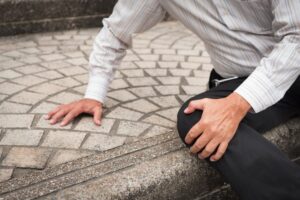
Before 2003, injured pedestrians generally had to pursue the city for sidewalk defects. Section 7-210, adopted by the City Council that year, changed the rule. It requires the owner of real property abutting a sidewalk to maintain the sidewalk in a reasonably safe condition, and it makes the owner liable for injuries caused by the failure to do so.
The law specifically covers an owner's negligent failure to:
- Install, construct, reconstruct, repave, repair, or replace defective sidewalk flags
- Remove snow, ice, dirt, or other material from the sidewalk
In everyday terms, a building owner may be liable for raised or cracked flags, holes, sunken slabs, crumbling concrete, and untreated ice.
The owner also cannot hand the legal duty to someone else. In Xiang Fu He v. Troon Management, the Court of Appeals held that the Section 7-210 duty is nondelegable: an owner can hire a tenant or contractor to do the work, but it remains liable to the injured pedestrian. That means a NYC premises liability lawyer can pursue the property owner directly, even if the owner points to someone else.
Who Is Exempt: Owner-Occupied One-, Two-, and Three-Family Homes
Section 7-210 does not apply to one-, two-, or three-family residential property that is at least partly owner-occupied and used exclusively for residential purposes. The city keeps responsibility for those sidewalks.
The exemption is narrower than many people assume. It generally does not cover:
- A one-, two-, or three-family house where the owner does not live
- A building with four or more units
- A property with a nonresidential use, such as a ground-floor storefront
Even the owner of an exempt home is not automatically off the hook. An owner who created the defect, or who made special use of the sidewalk, such as for a driveway, may still face liability under general negligence rules.
When the City Is Responsible, and Why Those Claims Are Harder
Suing the City of New York over a sidewalk fall involves two hurdles that do not apply to private owners.
The prior written notice rule and Big Apple maps
Under Administrative Code § 7-201(c)(2), the city generally cannot be sued for an injury caused by a defective sidewalk, street, or crosswalk unless it received written notice of the specific defect and failed to repair it within 15 days.
The statute also allows claims based on the city's written acknowledgment of the defect, or on a prior injury at the same defect that was reported to a city agency in writing.
Written notice often comes from maps prepared by the Big Apple Pothole and Sidewalk Protection Committee and filed with the Department of Transportation (DOT). In Katz v. City of New York, the Court of Appeals treated these maps as notice and held that the most recent map filed before the accident counts.
When the city can be liable without written notice
Without prior written notice, a claim against the city usually fails unless an exception applies. In Yarborough v. City of New York, the Court of Appeals recognized two: the city affirmatively created the defect through negligent work that immediately resulted in the dangerous condition, or a special use of the sidewalk gave the city a special benefit.
How the deadlines differ from private claims
Claims against the city also require a notice of claim within 90 days under General Municipal Law § 50-e and a slip and fall lawsuit within one year and 90 days under § 50-i.
A claim against a private owner under Section 7-210 generally must be filed within three years under Section 214 of the Civil Practice Law and Rules (CPLR), and exceptions, such as those for minors, can extend the time to sue.
Can a Store or Other Commercial Tenant Be Responsible?
Many NYC sidewalks run in front of stores, restaurants, and offices that lease their space. Section 7-210 puts the duty on the property owner, not the tenant.
When a tenant can still be liable
A tenant can still be liable in narrower situations, such as when it created the defect or made a special use of the sidewalk for its own benefit, like installing a cellar door or ramp that it controls.
In Fuentes v. Parkchester South Condominium, a June 2026 decision, the Appellate Division, First Department, held that the mere receipt of manual deliveries over a sidewalk, however frequent, is not a special use, even when the deliveries pass through a cellar door.
Who Must Clear Snow and Ice From NYC Sidewalks?

The abutting property owner generally must, because Section 7-210 expressly covers the failure to remove snow and ice. Under Administrative Code § 16-123, owners must clear the sidewalk within four hours after snow stops falling, not counting the hours between 9 p.m. and 7 a.m.
The storm-in-progress rule
New York courts also apply the storm-in-progress rule: an owner's duty to deal with storm conditions generally does not begin until a reasonable time after the storm ends. Timing records such as weather data, photos, and video are often central to these cases.
Is There a Minimum Size for a Sidewalk Defect?
No. Property owners often argue that a defect was too small to matter, a claim often called the trivial defect defense. In Hutchinson v. Sheridan Hill House Corp., the Court of Appeals rejected any "minimal dimension test."
What makes a small defect dangerous
A small height difference can still be actionable when jagged edges, poor lighting, heavy foot traffic, or nearby defects make it more dangerous. Courts look at all the facts and circumstances, not just a tape measure.
How to Prove a Sidewalk Slip and Fall Claim
Sidewalks change quickly. Owners repair flags, and snow melts. Strong evidence usually includes:
- Photos of the defect from several angles, with a coin or ruler to show its depth or height
- The exact address and location of the flag, measured from a fixed point like a building entrance
- Names and contact information for witnesses
- Video from nearby storefronts, doorbell cameras, or building security systems
- DOT violation records, Big Apple maps, and 311 complaints about the location
- Medical records that link your injuries to the fall
These records matter for determining slip and fall fault, especially when the owner, a tenant, a contractor, and the city all point at one another.
What If You Should Have Seen the Defect?
Owners and their insurers often argue that a raised flag or a patch of ice was obvious and that you should have walked around it. That argument usually does not defeat a sidewalk claim by itself.
In Westbrook v. WR Activities-Cabrera Markets, the Appellate Division, First Department, which hears appeals from Manhattan and the Bronx, held that an open and obvious hazard does not relieve an owner of the duty to keep its property reasonably safe, although it is relevant to the injured person's own share of fault.
How your share of fault changes the recovery
New York follows a pure comparative negligence rule under CPLR 1411, so your recovery is reduced by your percentage of fault but not barred. Suppose, hypothetically, a jury values your slip and fall damages at $80,000 and finds you 40 percent at fault because the raised flag was visible in daylight; you would recover $48,000.
NYC Sidewalk Slip and Fall Liability: Questions Answered by Our Attorneys
These questions come up often after a fall on a New York City sidewalk.
How can I find out who owns the property where I fell in NYC?
The deed recorded with the city usually identifies the owner, and the NYC Department of Finance lets anyone search deeds online for most NYC properties through the Automated City Register Information System (ACRIS). Because many buildings are owned through a limited liability company or managed by an agent, a lawyer often confirms who owned and controlled the property before filing a claim.
Is the city responsible for a sidewalk fall in front of a city-owned building or park?
Generally yes, because the City of New York is the abutting owner, but it keeps its prior written notice protection. In Tucker v. City of New York, a 2011 First Department case, the court ruled that the city could not be held liable without prior written notice, even though it owned the property next to the sidewalk.
Who is responsible for a broken grate or utility cover in a NYC sidewalk?
Usually the utility company or the property owner. A DOT rule in Title 34 of the Rules of the City of New York requires owners of covers and gratings to monitor the hardware and the surrounding 12 inches and keep it flush with the sidewalk. That duty can overlap with the abutting owner's duty under Section 7-210, so more than one party may be responsible.
What if I fell on a curb, in a tree well, or on a corner ramp?
Curbs, tree wells, and pedestrian ramps at street corners are not part of the "sidewalk" under Section 7-210, so the adjacent owner is usually not liable unless it created the defect or made special use of the area. Claims against the city for these areas can still require prior written notice.
Is a store responsible for snow and ice on the sidewalk in front of it in NYC?
Usually not, unless the store also owns the building. Section 7-210 of the NYC Administrative Code makes the property owner liable to pedestrians for failing to clear snow and ice from the abutting sidewalk, and New York courts generally hold that a commercial tenant owes an injured pedestrian no duty for snow or ice that builds up there naturally.
A store can still be liable if its own shoveling or salting made the sidewalk more dangerous, or if it made special use of the sidewalk. A lease that requires the store to clear the sidewalk does not remove the owner's responsibility to the person who fell.
Sorting Out Who Answers for Your Fall

Recovering from a sidewalk fall is hard enough without figuring out which owner, tenant, or agency is responsible for the broken flag. Washor Kool Sosa Maiorana & Schwartz, LLP investigates sidewalk falls across the Bronx, Brooklyn, Manhattan, Queens, and Staten Island, starting with the deeds, city maps, and repair records that show who controlled the spot where you fell.
Our attorneys have recovered over $1 billion for injured clients. For a free consultation about your fall and property owner liability, contact our NYC slip and fall attorneys. We are available 24/7 at 212-406-1700, and our office is in the Woolworth Building at 233 Broadway #2020, New York, NY 10279.
Every case depends on its own facts, and no outcome can be predicted or promised. This article provides general information and is not legal advice.
Attorney Advertising. Prior results do not guarantee a similar outcome.