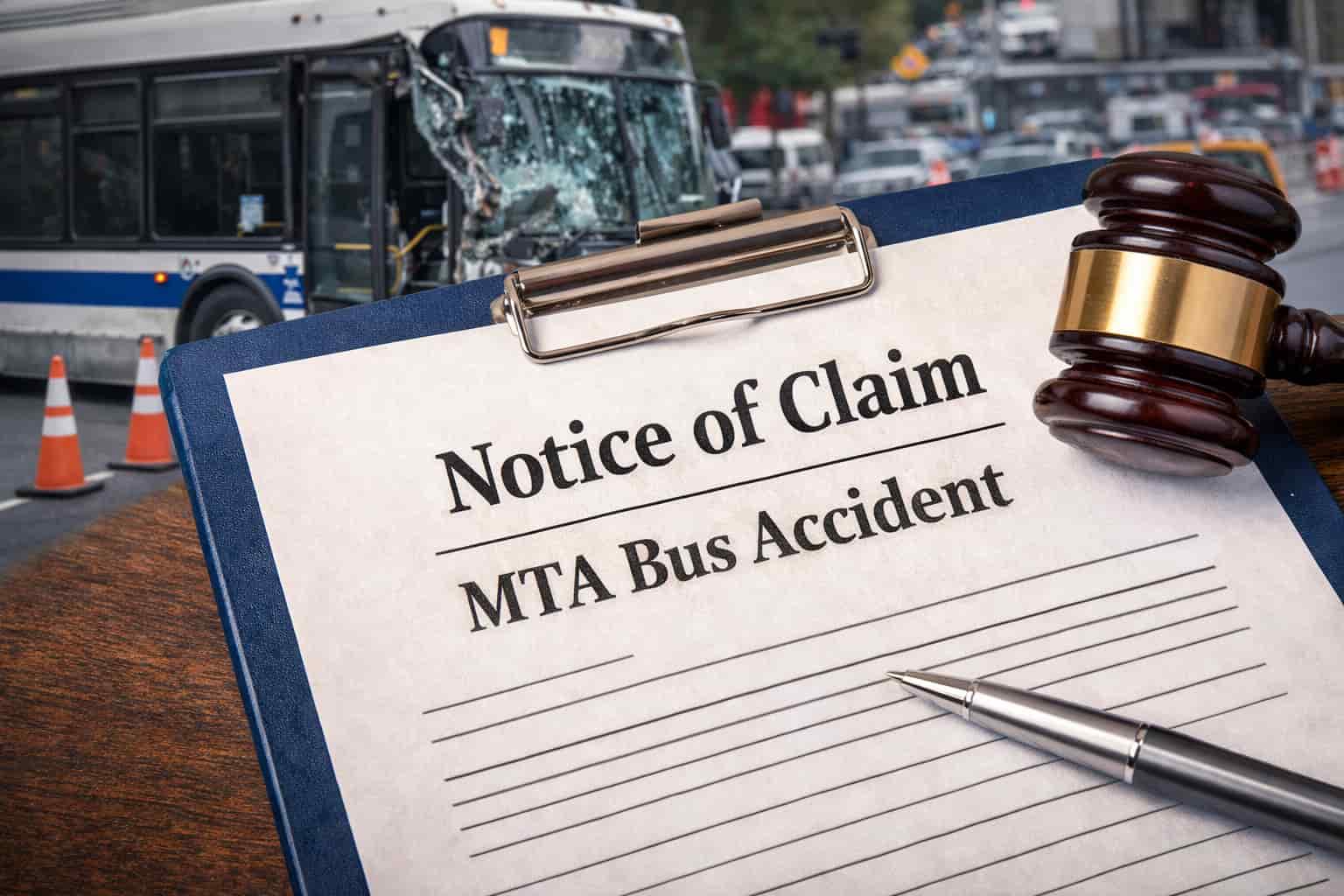
The MTA bus accident notice of claim is a formal written document that must be filed with the MTA within 90- days of an accident before any lawsuit can be brought against the authority.
Miss that deadline, and the right to sue is gone in most circumstances, regardless of how serious the injuries are or how clearly the MTA was at fault. This rule catches more people than almost any other procedural requirement in New York personal injury law.
Someone hit by an MTA bus in Brooklyn has three years to sue a private driver but only 90- days to preserve their right to sue the MTA. Those two timelines feel dramatically different when someone is recovering from serious injuries, dealing with medical appointments, and not yet thinking about litigation.
The clock does not care when it comes to the 90-day deadline in MTA lawsuits,. A New York bus accident lawyer can ensure your notice of claim is filed on time and correctly.
Schedule a Free Case Evaluation
Key Takeaways
- The notice of claim must be filed within 90 days of the accident date, not when injuries were discovered or when treatment was completed. The clock starts the day of the crash.
- Missing the 90-day deadline permanently bars a lawsuit against the MTA in most circumstances. Courts grant exceptions rarely, and the most common reasons people give for missing the deadline are the ones courts most often reject.
- After the notice is filed, the MTA may require a sworn examination before any lawsuit proceeds. How that examination is handled matters significantly for the case that follows.
What the Notice of Claim Requirement in NYC Actually Is and Why It Exists
The notice of claim is not a lawsuit. It is a formal written notification required by General Municipal Law Section 50-e, available through the New York State Legislature, that must be served on a municipal entity or public authority before suing for an MTA bus accident. The MTA, as a public authority, falls squarely within this requirement.
The purpose behind the rule is to give government entities early notice of potential claims so they can investigate while evidence is still fresh, preserve records, and make informed decisions about how to respond. That purpose benefits the government.
It creates a significant burden for injured people who have no idea the rule exists.
Who the Rule Applies To
The notice of claim requirement applies to any lawsuit against a New York municipality or public authority, including:
- The Metropolitan Transportation Authority and its subsidiaries
- New York City Transit, which operates city buses and subways
- The MTA Bus Company, which operates express bus routes
- New York City itself, when city-owned vehicles or property are involved
- Other public authorities and municipal agencies across the state
A private bus company, charter service, or rideshare vehicle operates under entirely different rules. The notice of claim requirement does not apply to private defendants, which is why the MTA's status as a public authority changes the entire procedural landscape for anyone hurt by one of its buses.
What Must Be Included in the Notice of Claim
The notice of claim is a legal document with specific content requirements. A notice that omits required information or contains material inaccuracies can be challenged by the MTA and may not satisfy the statutory obligation even if it was filed on time.
Required Elements Under General Municipal Law Section 50-e
- Date, time, and location of the accident: The specific intersection, bus stop, or location where the incident occurred, described with enough precision to allow the MTA to identify the relevant bus, route, and driver
- How the accident happened: A description of the circumstances, including the conduct of the MTA bus operator that caused or contributed to the incident
- Nature and extent of injuries: A description of the physical harm suffered, the body parts affected, and the type of treatment received or anticipated
- Damages claimed: The categories of loss being asserted, including medical expenses, lost income, and pain and suffering
The notice does not need to contain the level of detail required in a formal complaint, but it must be specific enough to put the MTA on notice of what is being claimed and where to direct its investigation.
Vague or generalized descriptions create grounds for the MTA to challenge the notice's adequacy later in the litigation.
Preparing an accurate and complete notice of claim requires information that takes time to gather, particularly when the injured person is still in the early stages of medical treatment and may not have a complete picture of the full extent of their injuries.
That tension between the need for detail and the narrowness of the 90-day window is precisely why legal involvement from the start matters so much.
Why the 90-Day Deadline Is More Unforgiving Than It Appears
Ninety days sounds like a reasonable amount of time. In practice, for someone recovering from an MTA bus accident, it disappears faster than expected.
- The clock starts at the accident, not at recovery: A person hospitalized for weeks after a serious bus accident does not receive extra time to account for the recovery period. The 90 days runs from the date of the crash regardless of physical condition, cognitive ability, or access to legal resources.
- Investigation takes time: Filing an accurate notice requires knowing the bus route, the operator's identification where possible, the precise location, and the specific circumstances of the crash. Gathering that information, particularly without legal assistance, takes weeks.
- Medical treatment dominates the early period: Injured people focus on treatment, follow-up appointments, and immediate financial pressures. Legal deadlines are not top of mind, and most people have no reason to know this particular deadline exists until someone tells them.
- Insurance calls create false comfort: The MTA's insurer or its representatives may make contact early after an accident. Those conversations do not substitute for a notice of claim. An insurance claim is not a legal notice. Filing one does not stop the 90-day clock or preserve litigation rights.
The 90-day deadline also intersects with a separate timeline for filing the actual lawsuit. Under New York law, a lawsuit against the MTA must be filed within one year and 90 days of the accident.
But no lawsuit can be filed at all without the prior notice of claim. Treating the lawsuit deadline as the primary constraint misses the earlier, more unforgiving requirement entirely.
What Happens After the Notice of Claim Is Filed
Filing a timely and complete notice of claim is the beginning of the process, not the end of it. What follows includes steps that have direct consequences for how the case develops.
The MTA's 50-H Examination
After receiving a notice of claim, the MTA has the right to require the claimant to appear for a hearing under General Municipal Law Section 50-h before any lawsuit is filed.
This examination is taken under oath and allows MTA representatives to question the injured person about the accident, their injuries, their medical treatment, and their claimed damages.
- Attendance is mandatory: Failing to appear for a properly scheduled 50-h examination can result in dismissal of the claim.
- Testimony is recorded: Everything said at the examination becomes part of the record and can be used by the MTA in building its defense throughout the litigation.
- Preparation matters: The MTA uses the 50-h hearing to identify inconsistencies, probe the extent of injuries, and gather information about prior medical history. Appearing without legal preparation exposes the claimant to questions designed to minimize the claim's value.
The 50-h examination is not a formality. It is a strategic event, and how it goes affects the litigation that follows.
The Exceptions to the 90-Day Rule and Why They Rarely Help
New York courts have the authority to grant leave to file a late notice of claim in limited circumstances.
The standard requires the petitioner to show a reasonable excuse for the delay, that the MTA acquired actual knowledge of the essential facts within 90 days or a reasonable time thereafter, and that the late filing would not substantially prejudice the MTA in its defense.
Frequently Asked Questions About MTA Bus Accident Claims in New York
Does filing an insurance claim count as a notice of claim?
No. Reporting an accident to the MTA's insurance carrier, completing an incident form, or participating in any informal insurance process does not satisfy the notice of claim requirement under General Municipal Law Section 50-e.
The notice must be a formal written document served on the MTA's Office of the General Counsel through the prescribed legal process. These are entirely separate steps, and completing one does not affect the obligation to complete the other.
What if I did not realize how serious my injuries were within 90 days?
The 90-day clock runs from the date of the accident regardless of when the full extent of injuries became apparent. If injuries worsened or new conditions emerged after the deadline, the notice of claim filed within 90 days should still describe the known injuries at that time.
Courts have held that a claimant need not have complete knowledge of all injuries within the 90-day window, but some notice must be filed within that period for any claim to survive.
Can I file the notice of claim myself without an attorney?
The notice of claim can technically be filed without legal representation. The practical reality is that a notice filed without proper legal guidance is more likely to contain errors, omissions, or vague descriptions that the MTA will later use to challenge the claim's adequacy.
The 50-h examination that follows also carries significant strategic stakes. Legal involvement from the earliest possible point protects both the notice itself and the case that builds from it.
What if the MTA bus accident also involved another vehicle or a private party?
Claims against private parties, such as a driver whose negligence contributed to the crash, follow the standard three-year statute of limitations and do not require a notice of claim.
The 90-day requirement applies only to the MTA and other public authority defendants. Cases involving both the MTA and private parties require managing two separate procedural frameworks simultaneously, which adds complexity and reinforces the value of immediate legal representation.
Does the 90-day rule apply to subway accidents as well as bus accidents?
Yes. The notice-of-claim requirement under General Municipal Law Section 50-e applies to claims against New York City Transit and its subsidiaries across all modes of transportation, including buses, subways, and paratransit services.
The same 90-day deadline, the same content requirements, and the same consequences for missing the deadline apply regardless of whether the injury occurred on a bus or a subway platform.
What if the MTA bus accident resulted in a death?
Wrongful death claims against the MTA are also subject to the notice of claim requirement. The 90-day window runs from the date of death, and the personal representative of the deceased's estate must file the notice on behalf of the estate before any wrongful death lawsuit can be brought.
The intersection of the notice of claim requirement and the wrongful death statute's two-year limitations period creates a timeline that demands immediate legal attention after a fatal MTA accident.
Ninety Days Passes Whether You Are Ready or Not

Most people who miss the notice of claim deadline did not make a reckless decision. They were hurt, focused on recovery, and had no idea a procedural clock was running in the background.
If you or someone close to you was hurt in an MTA bus accident in New York City, how many of those 90 days are already behind you? Washor Kool Sosa Maiorana & Schwartz, LLP represents people injured by MTA and city transit vehicles across New York.
A consultation costs nothing and starts with an immediate review of where the timeline stands and what options remain available.